The Google Ad Placements Your Competitors Aren't Buying (And Why That Gap Won't Last)
Most local service businesses run one type of Google ad and call it done. Performance Max opens seven more placements, including YouTube Shorts, Gmail, Google Discover, and display, and most competitors haven't touched them yet. Here's the live data: $374 spent, $2,032 back, 5.42x ROAS in the last 7 days.
We turned on a new campaign type for the detail shop in Seattle. The first three days, we spent $167. It came back $668. Four to one.
So we kept it running.
In the last seven days, that same campaign spent $374 and brought back $2,032. That’s a 5.42x return. The machine learned. The ROAS went up, not down.
The interesting part isn’t the number. The interesting part is where that money ran. Not on the standard Google search results page. Not on the map. Across YouTube Shorts. The Discover feed. Gmail. The display network, which is three million websites, apps, and content platforms stitched into a single ad network.
And almost no one in the local detailing market is using it yet.
Prefer to watch?
The one-placement problem
Most local service businesses run one type of Google ad. Usually it’s the text ads on search. Someone types “car detailing near me,” the ad shows, they click. That works. But it only catches people at the exact moment they’re searching.
The moment of intent is real. It’s valuable. But it’s also a small slice of your potential customer’s day.
What about the other 23 hours?
That’s the gap Performance Max is designed to fill. One campaign, one budget, and Google distributes your ads across every placement it owns, optimizing continuously based on where your audience is most likely to convert.
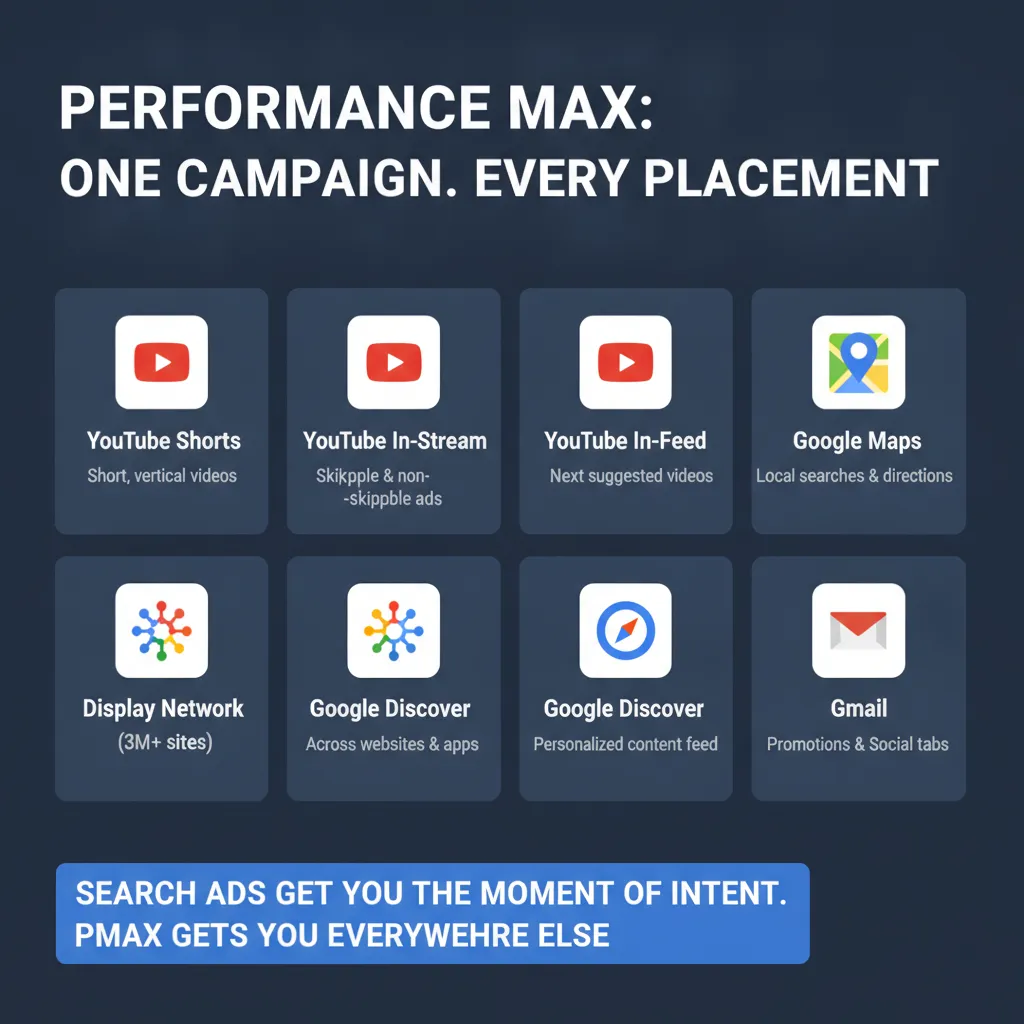
Here’s what that actually covers:
What you’re actually buying
YouTube Shorts: 40 million daily US viewers. The mom whose backseat is covered in goldfish crumbs has not searched for detailing. But she’s in the Shorts feed tonight. A 15-second clip showing a before-and-after transformation hits differently there than a text ad ever could.
YouTube In-Stream: the pre-roll before a video plays. Someone’s watching a car review. A car care tutorial. A detailing breakdown. They’re already in the mindset. Your ad shows up in that context instead of interrupting a cooking video.
YouTube In-Feed: suggested content in the recommended column. When someone is deep in a YouTube rabbit hole, your video shows as a suggestion. These placements convert when someone chooses to engage, not when they’re interrupted.
Google Maps: the sponsored pin that appears above the organic map results. This is where the map pack and paid ads overlap. You can buy a pinned placement at the top of the map for competitive searches, separate from your organic map ranking.
Display Network: roughly three million websites, apps, and platforms where Google can serve display ads. News sites. Recipe blogs. Sports scores. Weather apps. Your visual ad follows your audience around the internet between their searches.
Google Discover: the feed that appears on the Google app homepage and on Android devices below the search bar. It’s algorithmically curated content for each user. You can appear there as a sponsored card that looks like a piece of content, not like an ad.
Gmail: a sponsored card that appears in the Promotions tab. The subject line is your ad headline. It opens like an email with your full ad inside. For local service businesses, these tend to show to people who’ve engaged with similar businesses before.
The campaign that runs between searches
Most of marketing is built around catching people at the moment they’re looking. Someone searches for something, you show up. That’s the whole model.
PMax is built around a different idea: own the moment of intent and plant yourself in the spaces between the moments.
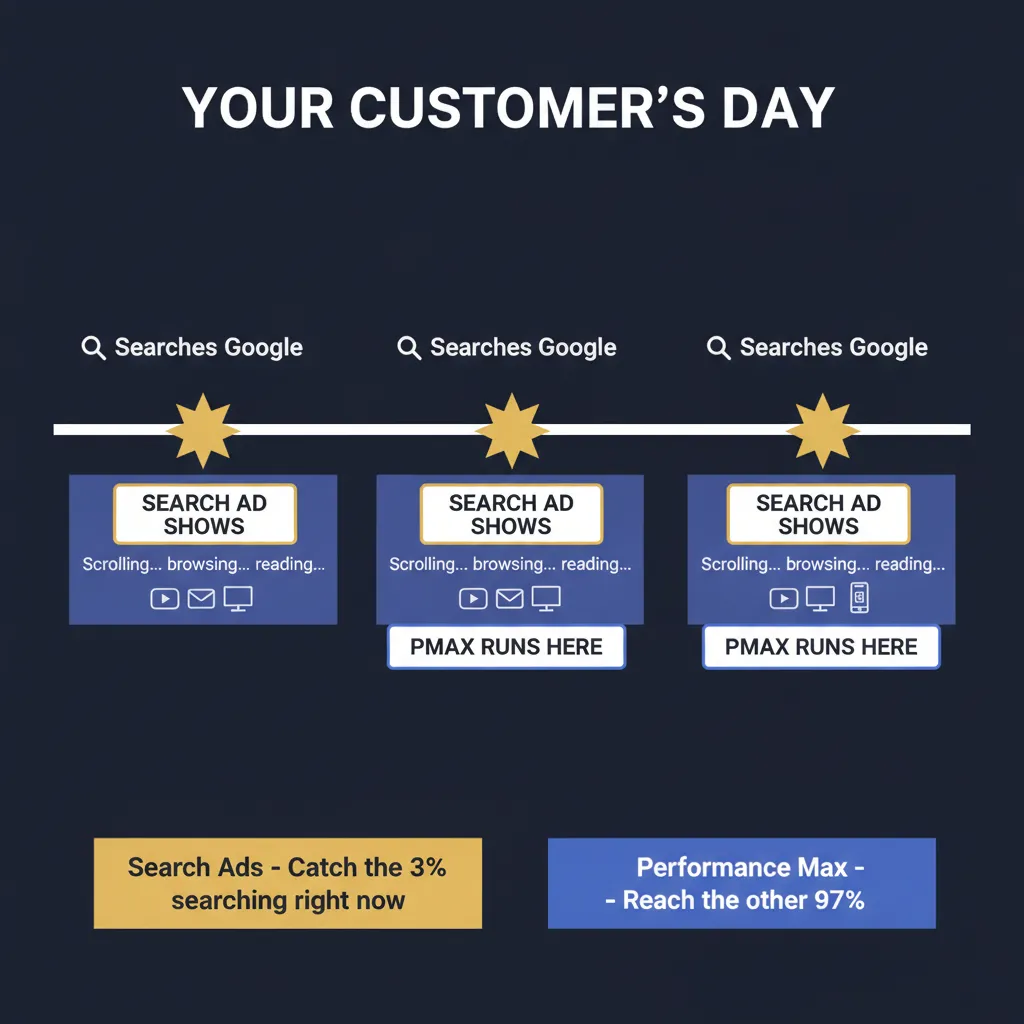
Think about what your customer does between searches. They scroll Instagram. They watch YouTube. They read news. They check Gmail. They browse websites with articles on things they care about. Every single one of those activities is a placement where PMax can reach them.
The person who searched “car detailing near me” last Tuesday and didn’t convert is still out there. Their car is still dirty. They just got distracted. PMax keeps you in front of them across the rest of their week.
That’s what “three million websites” actually means. Not three million random banner ads. A persistent presence around the audience that has already shown buying intent.
Why it’s cheap right now
Performance Max ad placements are under-indexed. They’re cheap, but not because the traffic is low quality. They’re cheap because your competitors haven’t shown up yet.
This is the opening.
Standard Google search ads have been heavily competitive in the local service category for years. Cost per click is high because every competitor is bidding on the same keywords. The map pack is crowded. LSAs have a waitlist and a verification process.
PMax opened a door that most local businesses walked past. The display network, YouTube placements, Discover, and Gmail. None of them have the same level of competition from other detail shops and cleaning services and pressure washing companies. The cost per thousand impressions is a fraction of what you’d pay on Facebook for equivalent reach.
That gap exists right now. It won’t exist forever. Once more businesses in the local service category figure this out, the CPMs go up and the edge disappears.
What the numbers actually are
The first test was $167 over three days. $668 back. Four to one. Good enough to keep running.
Here’s what it looks like now that the machine has had time to learn.
Last 7 days:
- Spend: $374.75
- Revenue generated: $2,032
- ROAS: 5.42x
- Cost per acquisition: $46.84
Last 30 days total:
- Spend: $480
- Revenue generated: $2,201
- ROAS: 4.58x
- Cost per acquisition: $53.34
The average job at this shop is $255. At a $47 CPA, every booking is returning 5.4x in revenue before the machine even finishes learning what it’s doing.
What’s interesting is the direction: the 7-day ROAS (5.42x) is higher than the 30-day ROAS (4.58x). That’s the campaign improving as it goes. Google’s algorithm is figuring out which placements and which audiences convert for this specific shop, and it’s getting more efficient with each passing week.
We were running at about 75% capacity. Twelve detail jobs a day is the ceiling, and eight of those twelve were coming from Google paid campaigns. PMax is now one of those eight sources, running quietly in the background at the cheapest cost per booking in the entire account.
The detail shop went from $20,000 a month to pacing $58,000. Most of that growth came from stacking placements, not from pouring more money into a single channel.
How to set it up
PMax runs on assets, not keywords. There’s no keyword bidding in a PMax campaign. Instead, you give Google a set of materials and it figures out how to combine them across placements.
The asset groups:
- Text: headlines, descriptions, business name, and a display URL. Write for the full range of placements. Some of these become display copy, some become video titles, some become Gmail subject lines. Don’t write for one format.
- Images: multiple aspect ratios. Landscape for display ads, square for in-feed, portrait for Stories-style placements. A real job photo (before and after, a clean car, a technician at work) outperforms stock.
- Videos: if you don’t supply a video, Google will build one from your images automatically. The auto-generated version is usually fine as a starting point, but a real 15-30 second clip of the work drives better results. A before-and-after transformation. A satisfied customer leaving the lot.
- Sitelinks, callouts, structured snippets: the same extensions you’d use in a standard search campaign. They give Google more to work with across every placement type.
- Audience signals: this is the lever most people miss. You’re not bidding on keywords, but you can tell Google who your best customers are. Upload your customer list if you have one. Point it at your converters. Let it learn from people who have already booked.
The campaign runs on a target ROAS or a target CPA. Set it, fund it, and let Google optimize the placement mix. It rebalances continuously based on which placements are converting.
What I’m watching next
The ROAS is improving on its own as the campaign learns. The next test is scaling the budget and seeing whether it holds.
What I want to see is the placement breakdown: how much is going to YouTube versus display versus Discover versus Gmail, and whether the $47 CPA holds as spend increases. PMax campaigns can get less efficient as you push more money through them. So far that hasn’t happened here.
YouTube Shorts is where I expect the bulk of the impressions to land. The CPMs are low, the audience is enormous, and a 15-second before-and-after clip in a local market is almost zero competition. That’s the hypothesis. I’ll show the data when we have enough spend to draw real conclusions.
The current numbers (5.42x ROAS, $46.84 CPA against a $255 average ticket) are good enough that I’d encourage any detail shop owner reading this to run a test before the market gets crowded. This window is open now.
Subscribe to the channel and I’ll post the results as the scale test runs.
Want a system like this for your business?
Check market availability →