5 Ways to Show Up on Google for Your Local Business (And Why Most Stop at One)
Most local businesses fight for a single spot on Google. Here's why that leaves money on the table — and the exact five placements you should be stacking, with real data from a car detail shop going from $20K to $58K a month.
When someone searches “car detailing in Seattle,” I want them to see that shop as many different ways from that one search as possible.
That’s the whole game. Not SEO. Not ads. Not the map pack. All of it, together, stacking on top of each other.
Here’s the problem. Most local business owners pick one of those things and go all in. Maybe they run some ads. Maybe they focus on the map pack. Maybe they do some SEO. And then they wonder why growth feels like pushing a boulder uphill.
They’re not wrong that those things work. They’re just playing a smaller game than they need to.
This post breaks down the five distinct ways a local service business can show up on a Google search results page, how each one connects to the others, and what that actually looks like in practice — with real numbers from a car detail shop in Seattle that went from $20,000 a month to pacing $58,000.
Prefer to watch?
Your score right now: how many times do you show up?
Here’s the exercise I want you to do. Go search your main service plus your city. Count how many times your business appears on that page.
That number is your score.
Most businesses score a zero or a one.
There are five placements on that page, five different ways to show up. Each one reaches a different type of searcher. Each one does a different job. And here’s the thing — none of them are optional if you actually want to own your local market.
Here’s what that page actually looks like for a real search in our market — count the placements:
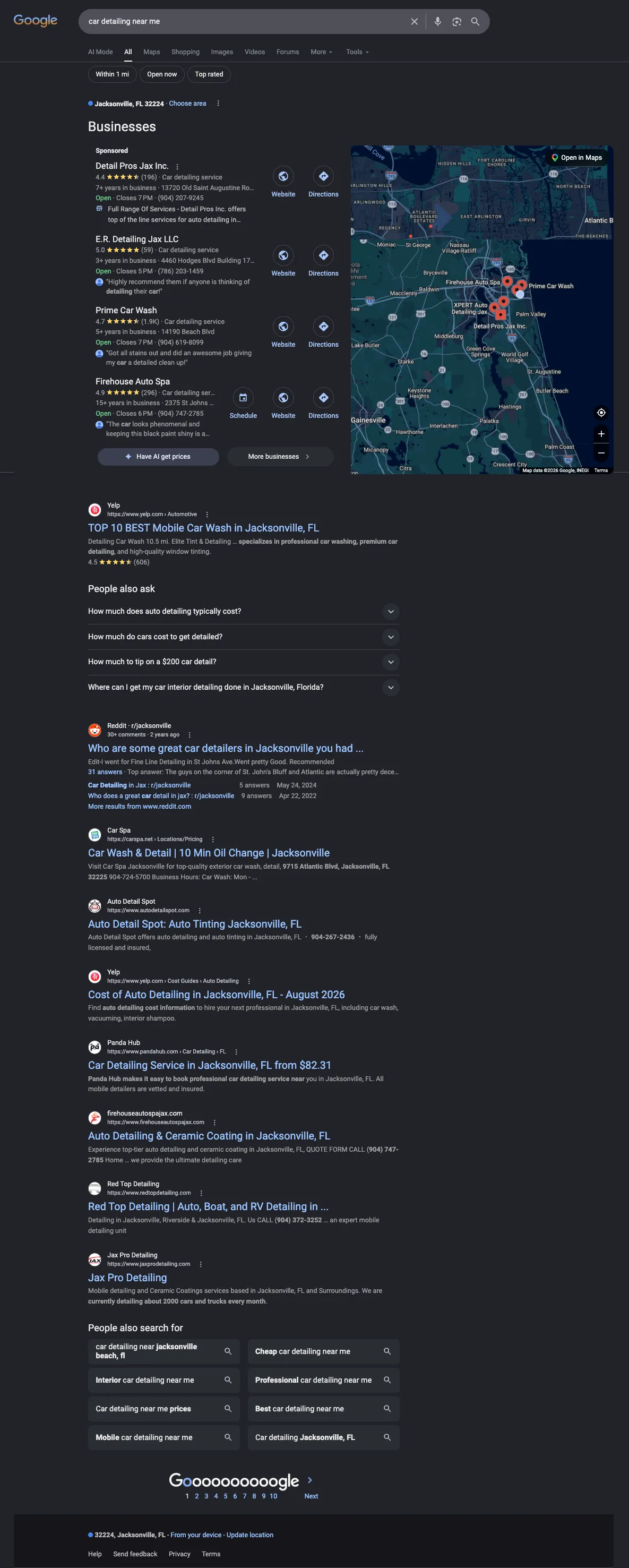
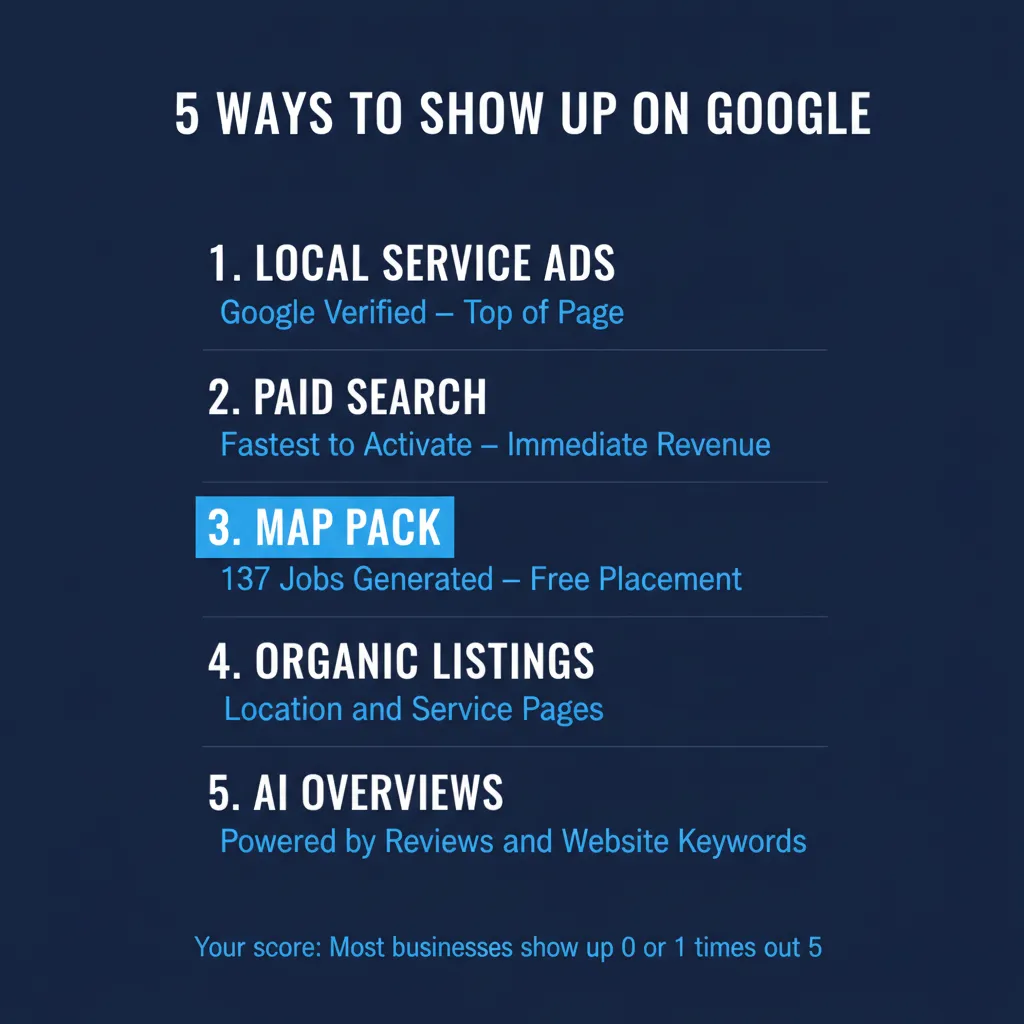
Placement 1: Local Service Ads
These sit at the very top. Above the ads. Above the map. The first thing anyone sees.
What makes them different is Google actually verifies the businesses that appear here. They’re passing their trust to the searcher — essentially saying “we’ve checked this one out.” That saves the person searching time on figuring out who to trust.
You have to apply to get in. There are minimum requirements. For local service businesses in the trades, it usually means background checks, license verification, insurance documentation.
It’s the most premium real estate on the page. And most small business owners haven’t even applied.
Placement 2: Paid Search (PPC)
These are the traditional text ads below the local service ads. Advertisers bid on keywords to show up here.
What I like about this placement is the speed. You don’t need a long history of reviews. You don’t need to have been in business for three years. You can be live and getting calls within a few days of turning it on.
It’s the most immediate way to make new bookings happen while you’re still building the organic side of things.
Placement 3: The Map Pack
This is where local businesses get a lot of their calls. Reviews are on display. The rating matters. The recency of the reviews matters. What people are saying in those reviews matters.
Google’s algorithm is taking in your location relative to the searcher, your review velocity, and the content of those reviews to decide who makes this list and in what order.
For the detail shop in Seattle, the map pack has generated 137 jobs — the single most valuable organic spot on the page.
The entry fee is simpler than people think. It’s your Google Business Profile, optimized, with reviews flowing in from every job.
Placement 4: Organic Listings
Below the map you have the organic results. For a local service business, that’s your service pages and location pages.
Here’s what I found when I actually dug into the data for the detail shop.
We built 30 location pages — one for every community around the shop. Ballard, Fremont, Shoreline, Edmonds, all of them. Most sit at the top of page one or page two for their community-specific searches. The structure worked.
Here’s what that looks like in practice — every community in the footer is a real indexed page:
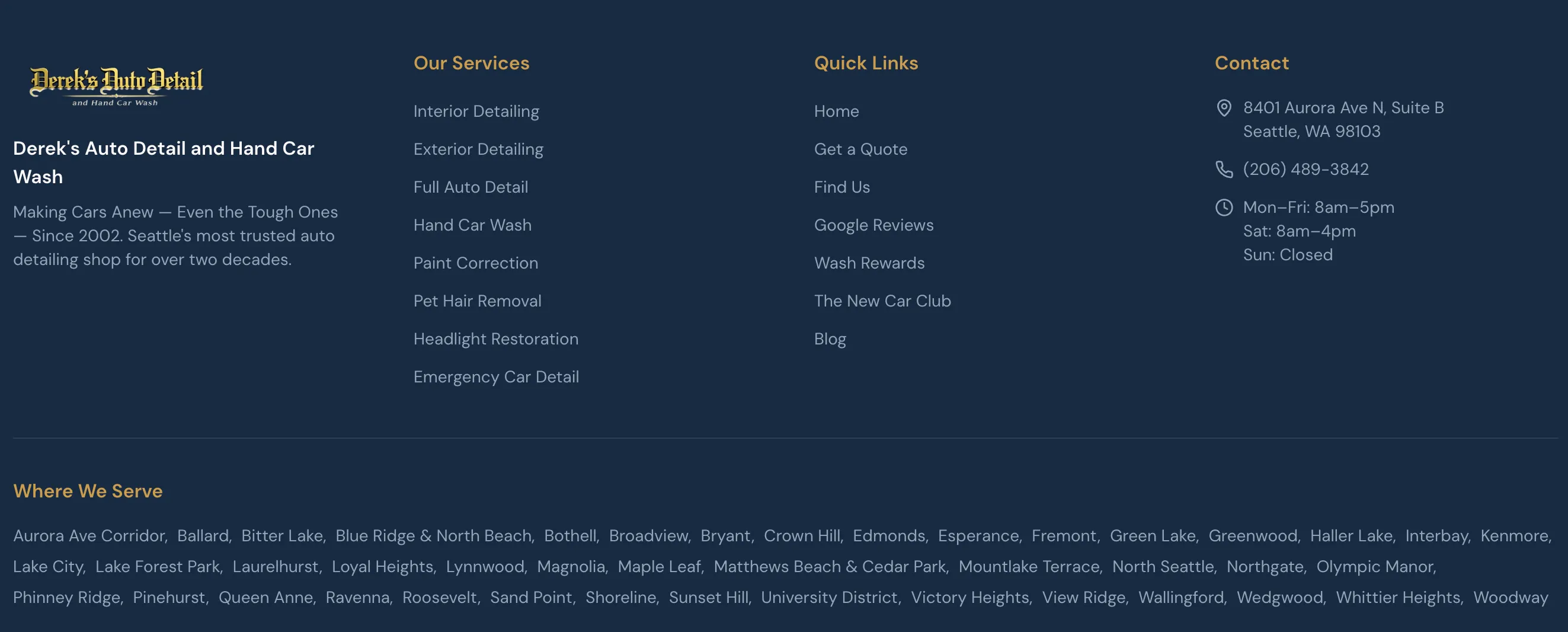
But in the last 90 days, those pages only accounted for 24 clicks from organic search.
Twenty-four.
Why? Because when someone searches “car detailing in Ballard,” what’s above the organic results? The map. The map gets that click the majority of the time.
And here’s the organic attribution broken down by page — you can see exactly where those clicks landed:
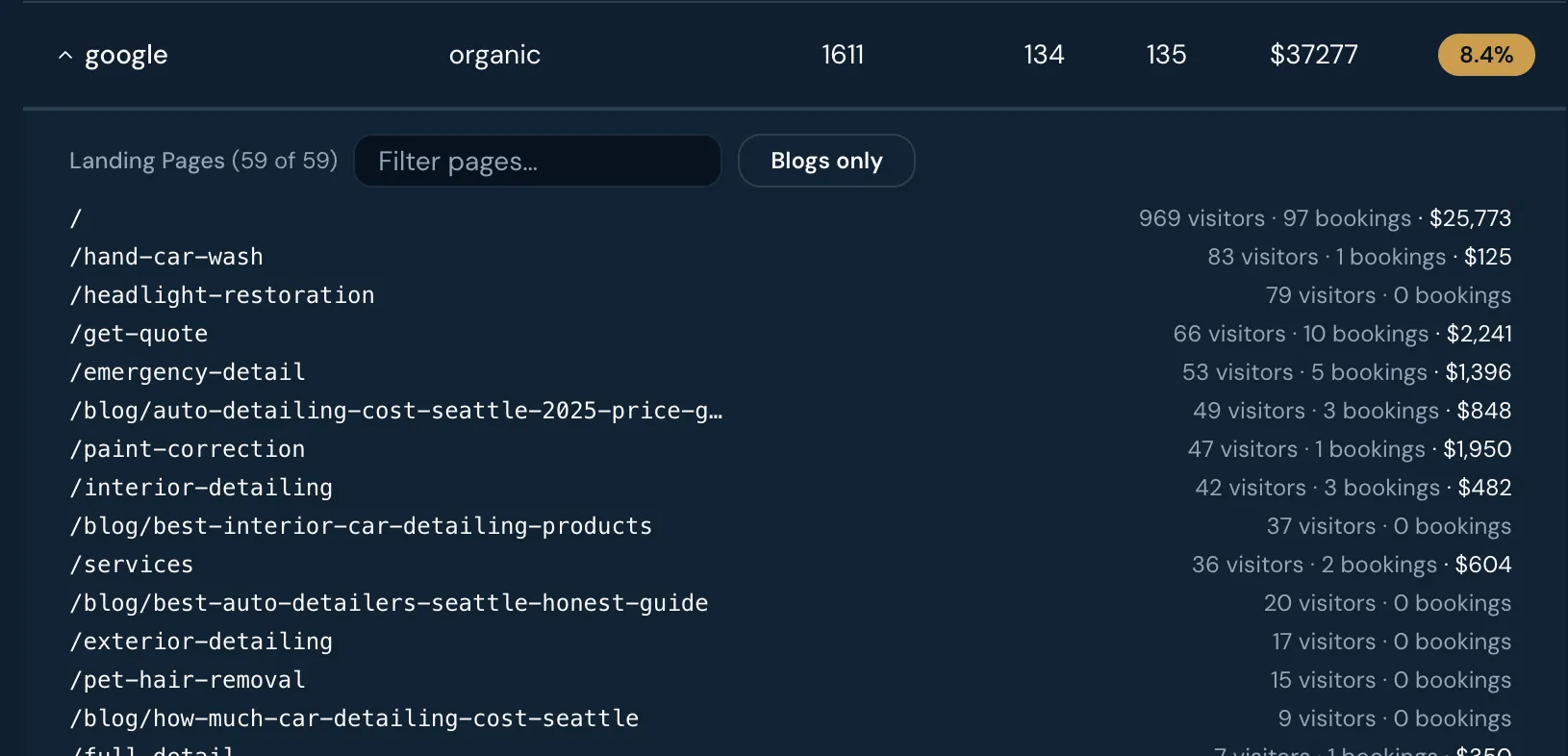
So were the location pages a waste? No. That’s the nuance that actually matters.
Those pages aren’t primarily there to catch direct organic clicks. Their job is to tell Google exactly what you do and exactly where you do it. That feeds your map pack ranking. A page ranking on page one is Google saying “I understand this business and I trust it for this area.” The website structure is the foundation the map pack sits on.
Those pages also double as ad landing pages. Someone in Edmonds clicks an ad and lands on the page about Edmonds — not a generic homepage. One asset doing two jobs.
Placement 5: AI Overviews
This one is still evolving, and there’s not a lot of reliable data on it yet. But here’s what I’ve seen.
A simple search like “car detailing near me” shows one set of results. But a more specific search — something like “who’s the most trustworthy car detailing shop near me that can handle oxidation and swirl marks” — triggers a completely different result. Google shows an AI-generated overview at the top, and below that are the organic pages that fed into it.
The companies that show up in those AI overviews are the ones that:
- Have those keywords somewhere on their website
- Have customers mentioning those specific things in their reviews
Here’s a live example — a search for “seattle car detailing greenwood” and Google’s AI Overview names Derek’s by neighborhood:
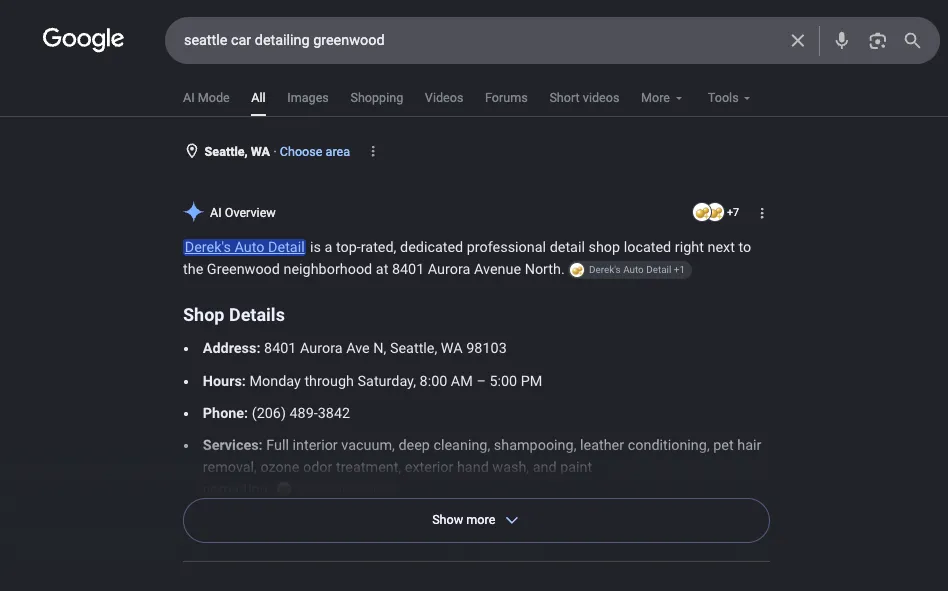
The path to showing up there runs directly through the work you’re already doing on your website and your review strategy.
What the data actually showed us
Here’s where the placements interact in ways most SEO people won’t tell you — because most of them never check.
We built the location pages. They feed the map pack. The map pack drives most of the organic bookings. People find the shop in the map or search the name, click through, and book. That’s the real click path for a local business.
Map first. Brand second. Organic listings third.
And then there’s the blog.
In the last 90 days, the blog pulled 115,000 impressions from search. Questions like “how much does car detailing cost” — that’s thousands of people meeting the brand while they’re still researching, days before they’re ready to book. When they finally are ready, we’re the name they’ve already seen.
How it actually spins
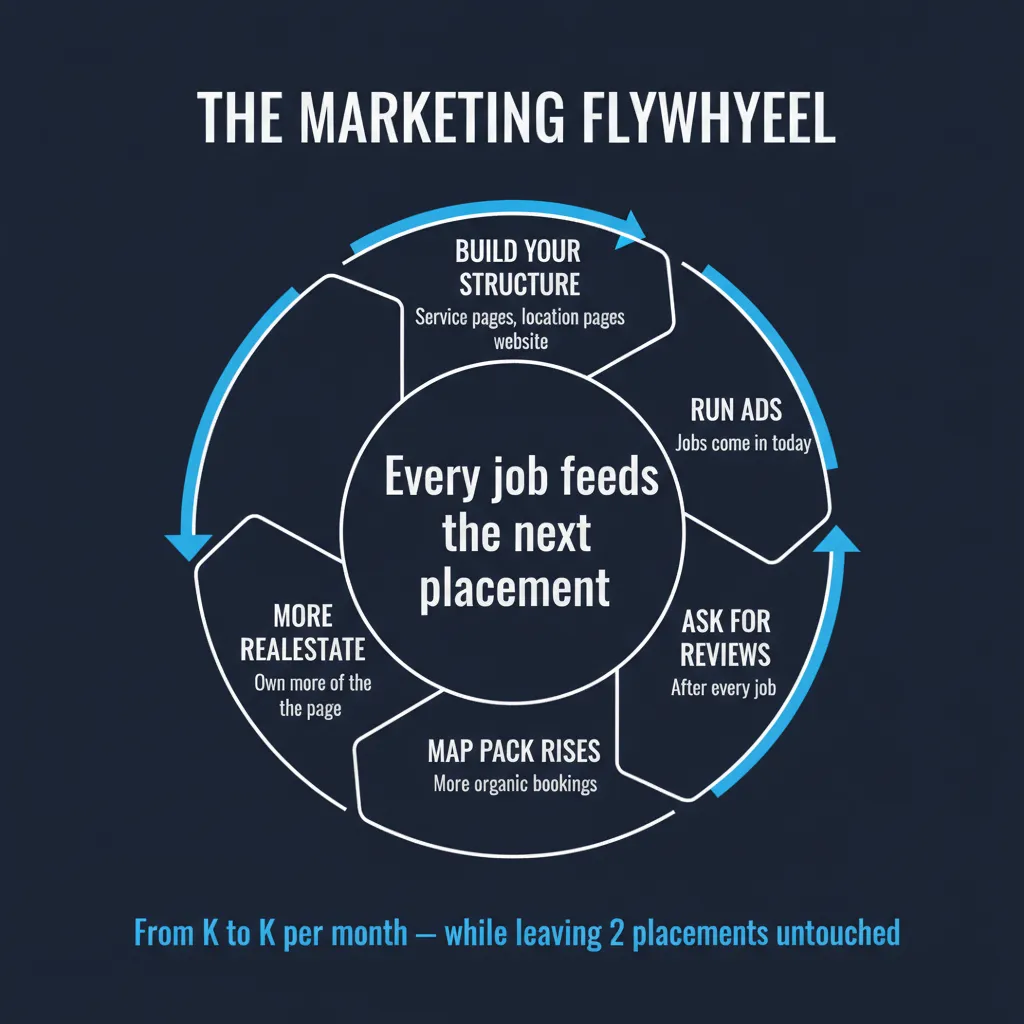
I call this the marketing flywheel.
Get the structure right and Google understands what you do. Run ads and jobs come in today. Ask for a review on every single job and reviews flow in from every community you serve. Reviews push your map pack rankings up. Map pack brings more organic bookings. More jobs, more reviews, more real estate.
Every job feeds the next placement.
That’s why I’ve stopped thinking in channels. I think in real estate. How much of that page do we own? Was it more than last month?
Here’s the honest scorecard for the detail shop right now. We show up in the map pack. We show up in organic. We’re running paid ads. The blog is building awareness for people still researching.
Two placements we haven’t fully turned on yet: Local Service Ads and Performance Max (the paid placement in the top of the map). We’ve only spent about $50 on PMax so far.
All of that growth from $20,000 a month to pacing $58,000 — happened while leaving two of these placements on the table. That’s how much room there is left to grow.
Your 5-step action plan
Step 1: Search your main service plus your city. Count how many times you appear. That’s your score. Zero or one is where most businesses start.
Step 2: Fix the map pack first. Optimize your Google Business Profile and start asking for a review on every single job. It’s the highest-value placement and it’s free.
Step 3: Fix your structure. A page for every service you offer. A page for every community you serve. All interlinked. Their job is to help Google understand you — and they double as landing pages for your ads.
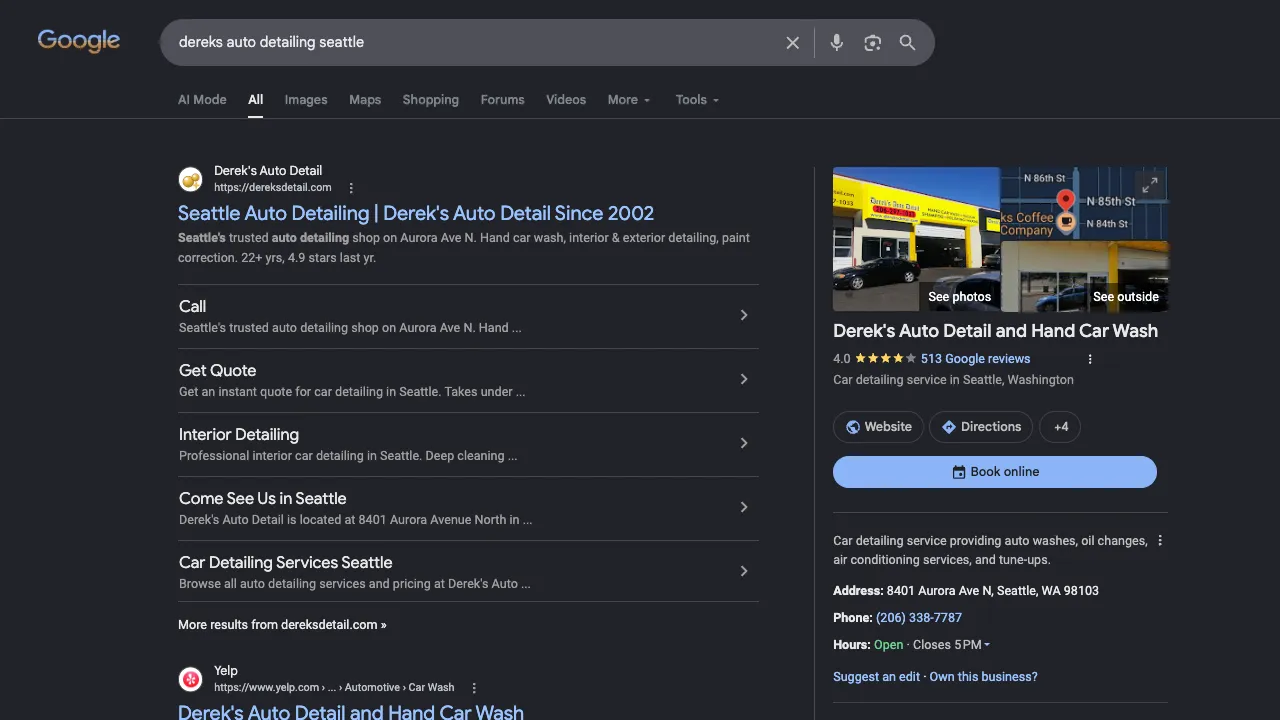
Step 4: Bid on your brand name. It’s the cheapest placement on the page. When someone comparison-shops three businesses and searches your name the next day to come back, you own that result. You’re not letting a competitor steal that click.
Here’s what it looks like when you own it completely — the shop controls the map pack, the organic listing, and the ad for the same branded search:
Step 5: Add paid search. You can be getting new bookings almost immediately. When you’re ready for the premium spots — LSAs and PMax — that’s the order we did it in.
Stack the placements. Own more of the page. Every job feeds the next one.
If you want to see what happens when we turn on the Local Service Ads, subscribe to the channel and I’ll show you the real numbers when we do.
Want a system like this for your business?
Check market availability →