The Master Brain: How to Add AI Into Your Car Detail Business Marketing
The playbook I use to run one of the most advanced marketing systems a local business can have. One place where every number flows in, and the free prompt that sets it up.
I built a business master brain for a local car detail shop in Seattle. In this post I’m going to show you how to run one of the most advanced marketing playbooks in 2026 for your detail shop, or really any local business.
Prefer to watch? Here’s the full video:
Nobody builds a house without a blueprint
House building always starts with a blueprint. Period. The lot. Where the house sits. The walls, the roof, the cabinets, the plumbing, the electrical. And the foundation, which is the most important part of all of it. Without a solid foundation you’d have houses falling down every time the wind blows.
That’s exactly what most of us do in business. We get so busy in the business that we never pull out and look at the foundation the business is built on.
More times than not, we get excited when things start going well and we start bolting little things onto the business. At some point you end up with a Frankenstein business. All these moving parts, and absolutely no coordination between any of them.
It’s not uncommon for a local business owner to know nothing about their own website. They don’t know what it’s built with. They can’t make a change without calling “the guy that does that stuff.”
Why your agencies aren’t moving the needle
Here’s the biggest problem I can pinpoint. Most local business owners try to fix marketing problems by hiring agencies to do tasks. One agency for SEO. One for ads. One for the Google Business Profile. One for lead gen. One for reviews. There’s an agency for everything now, and you’re probably getting served their ads day after day.
It’s not that agencies are bad. Having one can be better than not having one. But there’s an important catch. You have to understand how that agency fits into your business blueprint.
Those agencies have no blueprint to follow for your business. And they’re not going to create one for you either. That’s why so many people have agencies that never move the needle.
Having a blueprint is the single most important thing you can do for your business going forward, because it makes every single thing you ever do in your marketing more successful.
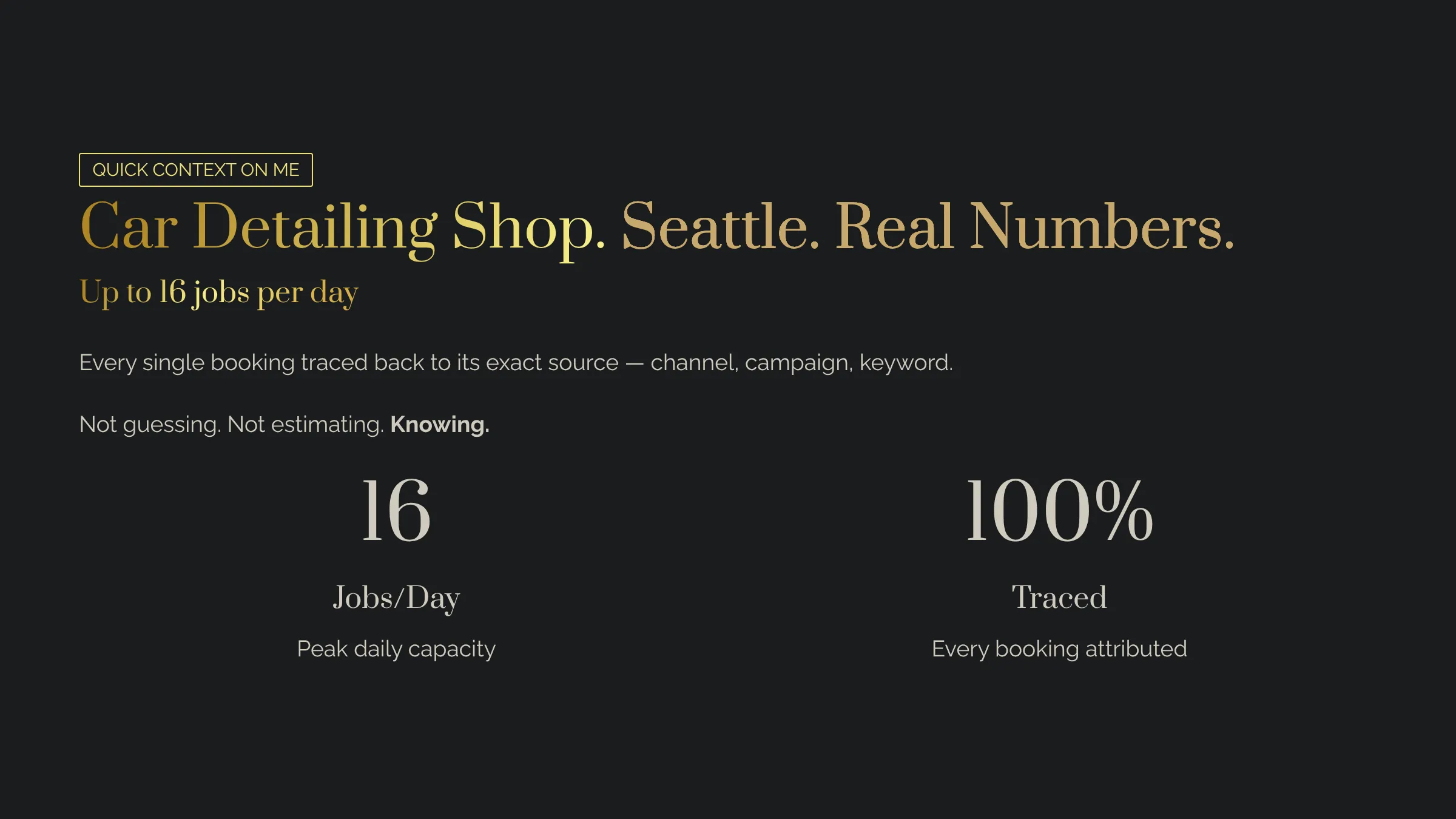
Quick context on me: I handle revenue operations for local service businesses. This is the playbook I’ve used to help a car detailing shop in Seattle book up to 16 detailing jobs in a single day. And I can trace every one of those jobs back to the ad or the search that generated it. That’s the system I’m going to show you the blueprint for.
The Business Master Brain
The first step is just mapping it out. How does everything connect? Two years ago what I’m about to describe wasn’t really possible. With the rise of AI, it is, and it lets you punch way above your weight class.
At the very top of the blueprint sits what I call the business master brain.
Just like your brain controls the movements of your body, the business master brain becomes the operating system of your business. Think of a conductor standing in front of a symphony. Dozens of instruments, all sorts of things happening at once, all working together to create one sound. That’s the job of the master brain layer in your business.
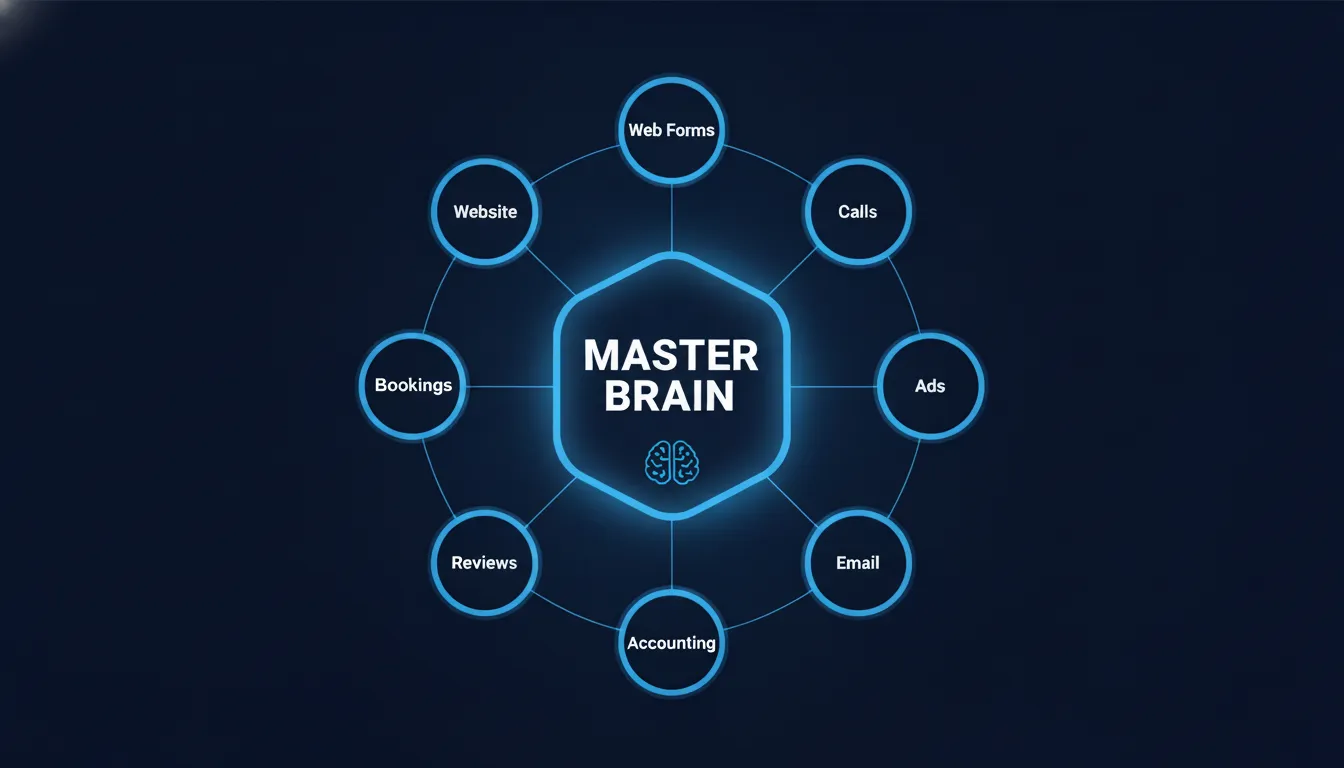
Without it, you keep adding tools that each handle one-off tasks, but none of them talk to each other. Even tools with their own built-in AI, like GoHighLevel, don’t communicate with your accounting tools or your advertising tools. Everything is scattered. So it ends up being you, the owner, trying to decipher information from ten different dashboards.
When there’s one architecture layer at the top, all of those tools feed into it. One place that helps you make the decisions that push your business forward.
What it unlocks
Here’s what I’ve wired into the master brain that I use every single day:
- Customer acquisition cost tracking. I know exactly what it costs to get a new customer into the shop.
- Repeat customer tracking. How many come back, what they’re worth, and their lifetime value.
- Funnel drop-off analytics. Where people bail out of the booking flow, so we can test fixes and unlock conversion.
- Lead source attribution. Which marketing channels are actually producing, and how much revenue each one generates.
- Upsell analytics. How much we lift the average ticket when the shop makes upsells.
- Customer journey tracking. How long it takes someone to become a customer, and how that path differs between Facebook and Google.
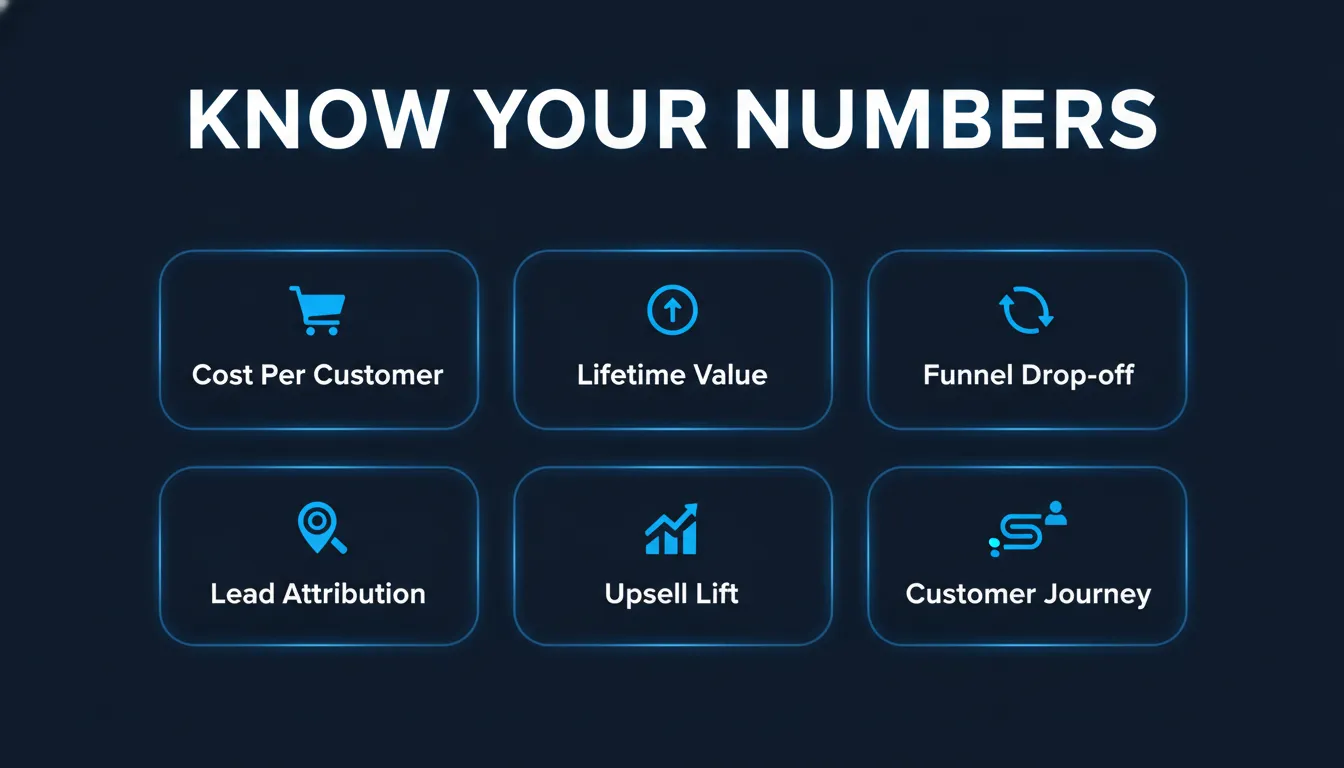
All of those reports are possible because everything flows into one place.
Here’s what that looks like in practice — a real customer journey from the master brain, first Google click to a confirmed $169 booking in 1.1 days, every touch tracked (name hidden for privacy):
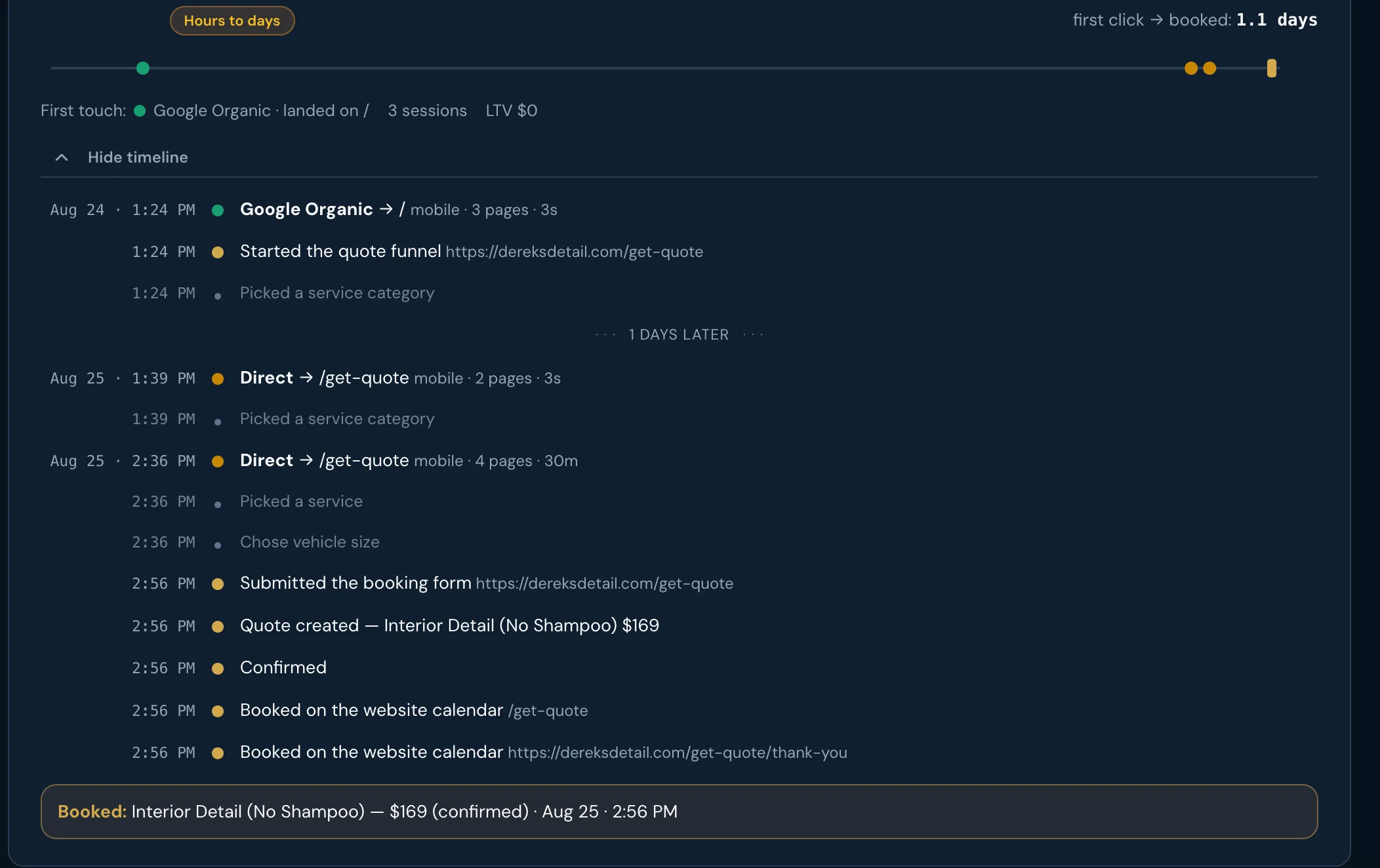
From there, I also have agents that tie into this layer and take button-pushing work off my plate. If you’re doing anything manually, even reading your email, you can probably get serious help from agents. I use them for Google Ads management, Facebook Ads management, building landing pages, ideating content, building hiring funnels to find talent, and putting brand assets together.
The key is that everything ties into one single place. It’s like being able to hire people, plug them into your system, and have them present information in a way that helps you make better decisions. You can’t build anything if you don’t know your numbers and how to influence them.
This is also where your documentation and operating procedures live. It makes everything else in the business easier.
How to install this today, for free
There’s a tool you’ve probably never heard of called Supabase. It’s a database with a ton of AI connectivity built directly into it. It’s free to start, and it gives you this architecture layer at the top of your business for nothing.
You sign up, you get a database, and now you have one place where everything in the business flows into. Web forms. Call tracking. Booking systems. Ad platforms. Emails coming into the business. All of it can feed into this one place.
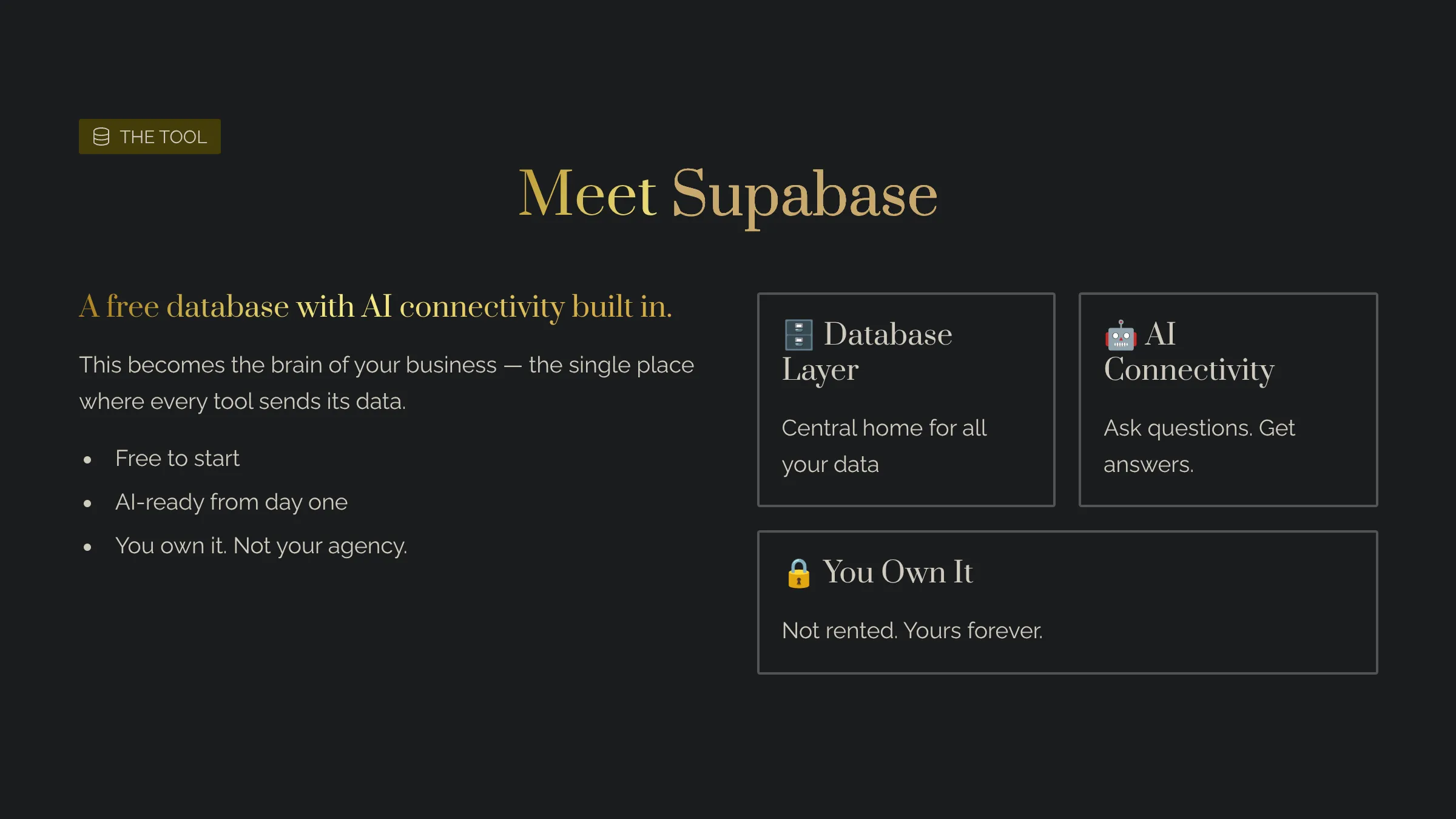
And the best part: you own it. Not your agency. Not your website guy. You.
Now here’s where it gets interesting. You’re probably thinking “cool, but I have no idea what to do.” So here’s the thing. If you use Claude or ChatGPT, you’re literally one question away. Type this in:
Can you help me set up an orchestration layer for all of my business data and tools to connect into Supabase as the database layer? I’d like this to become the operating system of my business, so I have a single location where I can get the truth on what’s going on in my marketing, my sales, and my operations.
I promise you Claude or ChatGPT can build this for you in a matter of minutes, and it will guide you along the way. That one prompt will kick you off and move you in a powerful direction right away.
This infrastructure is brand new to the market. Almost nobody knows it exists yet. You don’t need to know how to code. You don’t need to hire a developer. And once it’s in place, it can do actual useful work on top of your real data for pennies.
As you get more skilled, you can build all sorts of things on top of it. Dashboards. Automated reports. Follow-up sequences. A system that tells you exactly what’s working and what isn’t. But the starting point is the database. One place everything flows into, that you own. That’s a real asset in your business.
Why this matters
We’re always chasing today’s leads, so we never operate with a solid foundation under us. Every dollar you spend on marketing leaks somewhere you can’t see.
Fix the foundational layer and everything you do in the next six months works better. Your organic posts. Your paid ads. Your Google Business Profile. Same effort, different results, because now it compounds instead of leaking out the other side.
Local marketing isn’t about being the most creative marketer in the world. It’s mostly about having good architecture in place and a simple playbook you can actually execute.
Flip through the deck
Prefer cards to paragraphs? The same blueprint, one idea per card:
If the deck doesn’t load, open it directly on Gamma.
Go execute
I’m breaking down every piece of the marketing blueprint that’s working for the detail shop on my YouTube channel. Subscribe, watch the videos as they come out, and go execute. I’m rooting for you.
Want to see the numbers behind the Seattle shop? Read the Derek’s Auto Detail case study.
Want a system like this for your business?
Check market availability →