I Built a Marketing System for a Local Car Detail Shop (Here Are the Numbers)
How a Seattle detail shop went from barely hitting $20K a month to pacing $58K in the last 30 days. The exact traffic sources, the booking counts behind each one, and the one fix that had to come first.
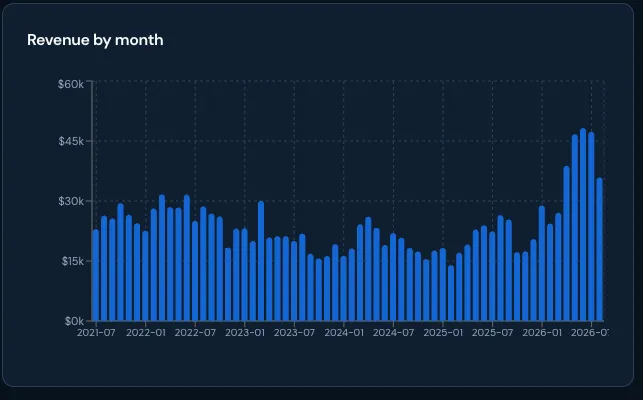
Over the last six months I’ve helped take an auto detail shop in Seattle from barely hitting $20,000 a month in revenue up to $48,000 a month. In the last 30 days we’re pacing $58,000. In this post I’m going to show you exactly where the bookings are coming from and how we turned things around.
Here’s the actual dashboard, so you don’t have to take my word for it. Five years of revenue hovering between $15K and $30K a month, then the system goes in and the last bars tell the story:
Prefer to watch? Here’s the full video:
Quick context on me. My name is Jason O’Neil. I’ve been in digital marketing and business building for the last 15 years. I built an 8-figure company in the past, and these days I’ve been going much deeper into the challenges local businesses face.
The shop belongs to a friend of mine, Derek. One day I just thought it would be a good idea to look at his website and see if there was anything I could do to help him out.
Fix this first, or nothing else matters
Before I get into the traffic sources, I need to show you what we fixed first. Without it, none of the traffic would have mattered.
The shop used to rely solely on the phone to book jobs, and they missed a bunch of those calls. So no matter what they did with their marketing, nothing moved the needle. And they’re not unusual. Around 30% of calls to small businesses go unanswered, and in home services about half of callers never reach a live person. I get why. The robocalls, the telemarketers selling marketing services. When the phone only rings a few times a week with real leads, it gets easy to ignore.
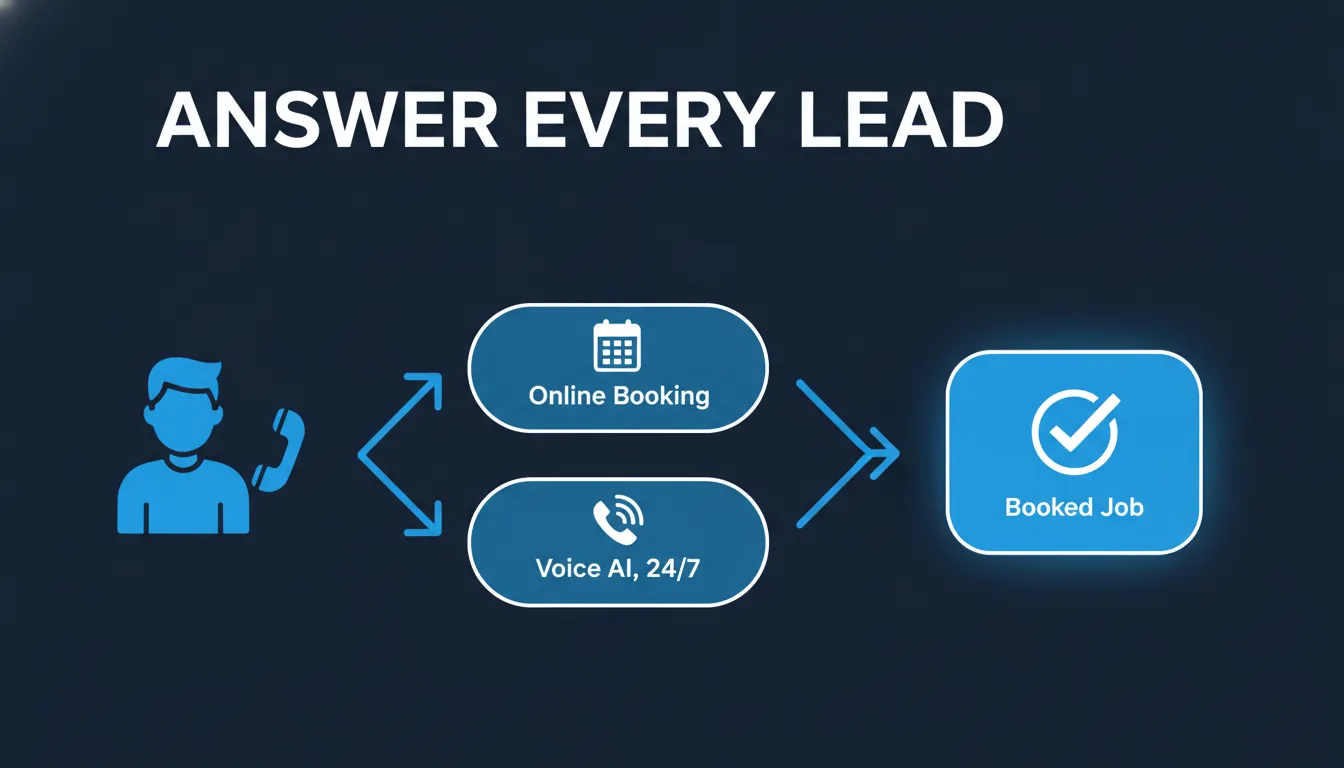
So we did two things, because people buy from your business in different ways:
- A booking system for the people who don’t want to talk to anyone. They get pricing and book their detail job without ever speaking to a person.
- A voice AI agent that answers every single call and captures the lead while they’re hottest, for the people who would rather pick up the phone.
I know what you’re thinking. Voice AI is scary. Is it going to make me look bad? It has pros and cons. The shop manager, like most local business owners I talk to, was not keen on the idea. He kind of hated it. The owner decided to do it anyway. Now the shop has customers coming in daily instead of a phone nobody answers. And honestly, the shop wasn’t far from closing its doors doing things the way they’d always been done.
I’m not here to sell you on voice AI. Even if it’s just you picking up every call yourself, the point stands: nothing in this post works until the phone gets answered. And I mean answered immediately, not after 30 seconds of ringing. You can’t advertise your business if you don’t answer your phone.
Source 1: The Google Business Profile (137 jobs)
The business profile has generated 137 jobs.
There’s no shortage of free information about optimizing your Google Business Profile. Yet in any given market, only a few companies in a niche ever do anything with it. The skepticism I hear is “I don’t trust marketing agencies.” Maybe that’s justified sometimes. But it’s not an excuse to skip the free information and leave your profile unoptimized. That’s leaving free money on the table.
Your Google Business Profile isn’t just a source of traffic. It’s the proof engine people need to feel comfortable choosing you. It’s the linchpin that holds the whole strategy together.
In our case, the shop didn’t have a good reputation. It had been around for years, with some years of neglect. A 3.6-star rating and years of bad reviews to overcome.
Today, six months later, we rank number one in the map pack for a bunch of targeted keywords. We got there by making one thing a priority: getting reviews. Every single time a job is completed, we ask for a review. It’s become part of the fabric of the company.
There are capable competitors in the same area, but we’ve been getting significantly more reviews than them, and we’ve steadily passed all of them in the rankings. Nothing else changed. The profile was already optimized. The velocity of reviews shows Google the shop is actively serving customers, and in those reviews, customers talk about the services they got done.
Second to that, we respond to every review that comes in. It’s best practice, and it lets you work a few extra keywords into your response, which also gets picked up by Google and the other search engines. Recent reviews tell both people and search engines that the company is actively doing business.
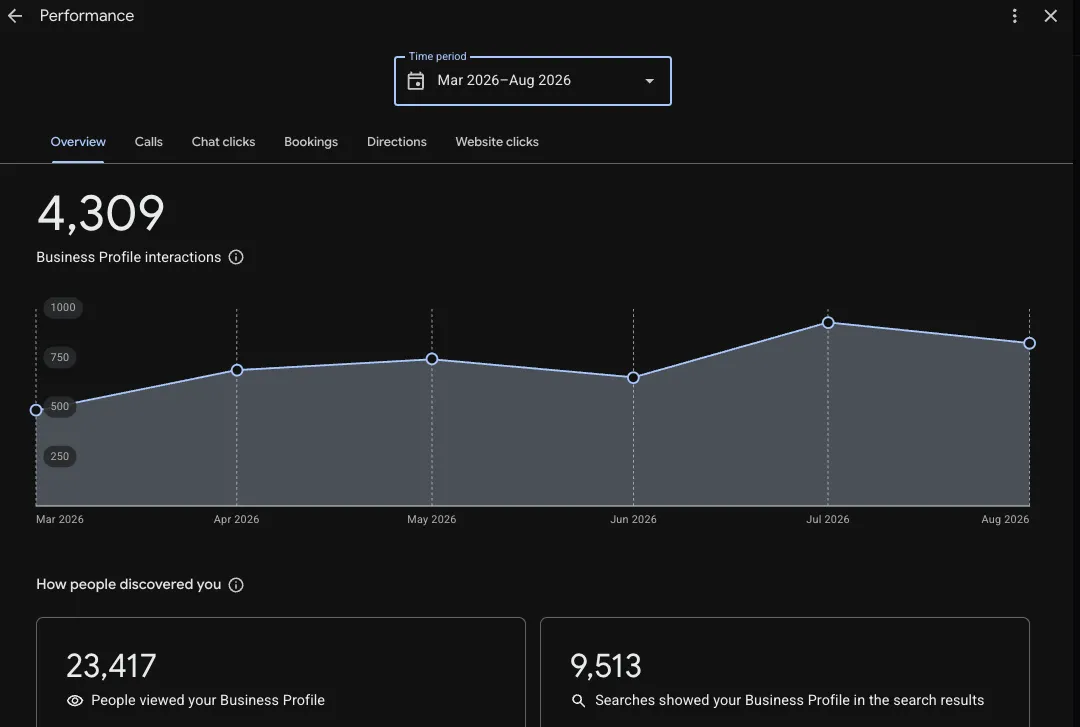
So far this year the shop has gotten 200 reviews. For context: in the previous 20 years they got about 300 total, and a lot of those were bad.
Here’s what that activity looks like from inside the Google Business Profile — this is the last six months:
Here’s the thing about reviews. Happy customers don’t typically leave them unless you ask. Upset customers don’t need to be asked. They’ll happily let the world know. But what we’re finding is that people don’t care about the negative reviews nearly as much as they care about how you address them. They’re hedging their risk. They want to see the worst-case scenario. Answer the negative reviews honestly and you’re solid. People can see you’re a human, and humans make mistakes. You just have to ask for the positive reviews, because those far outweigh the negatives.
Source 2: The website and local SEO (164 bookings)
Next, we fixed the website and got to work on local SEO. This is currently the biggest growing channel.
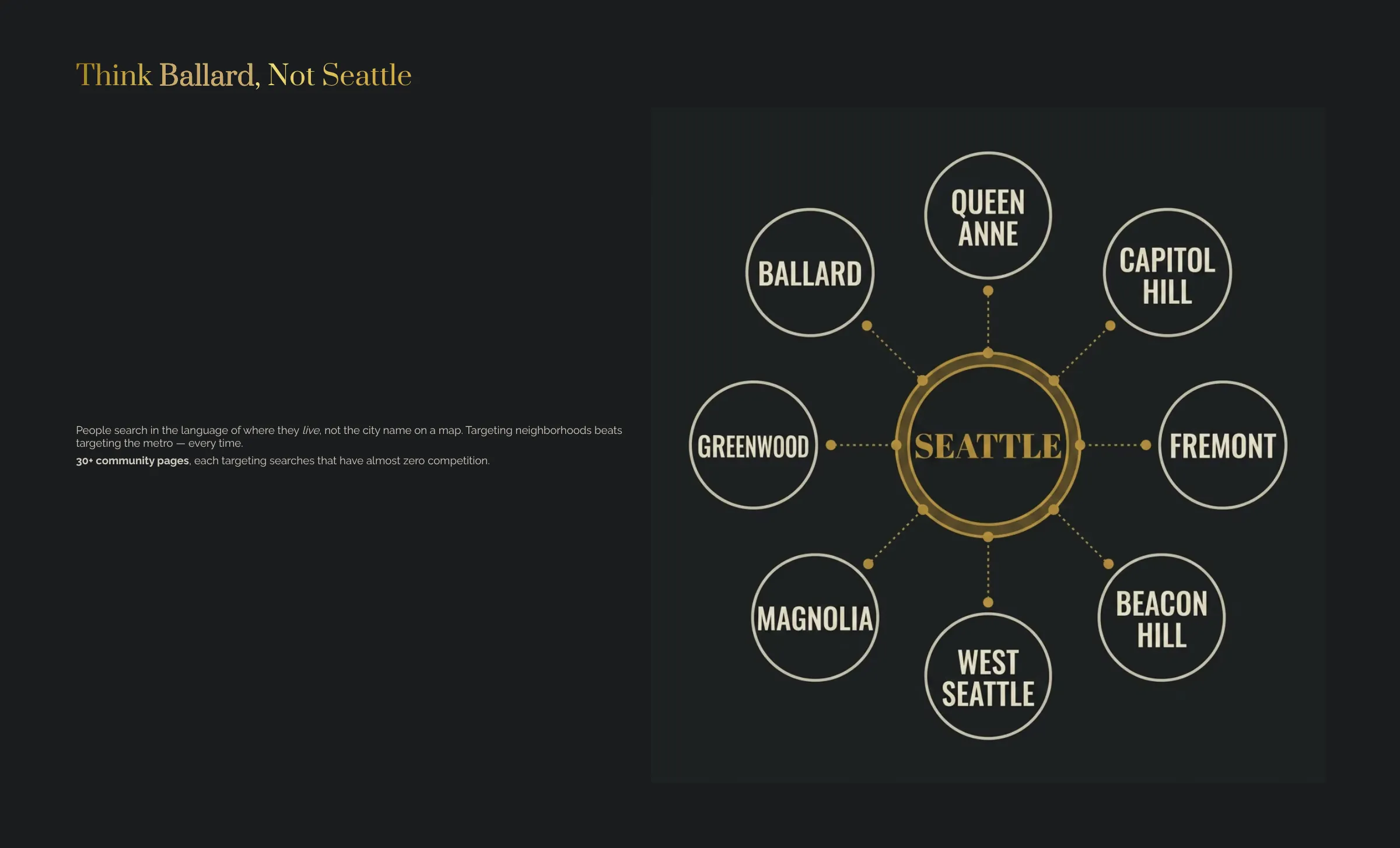
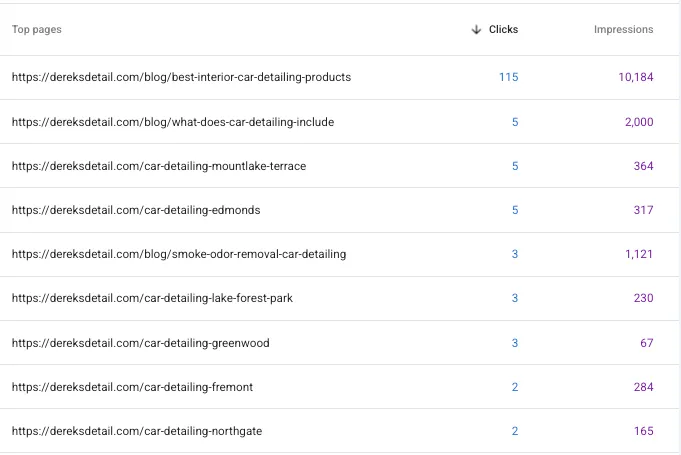
In plain speak: the new website has a page for every single service they offer. But here’s the key. It also has pages for the areas they serve. And by areas I mean the communities people actually live in. People in Seattle don’t talk in terms of “Seattle.” They talk about Ballard. So instead of one location page for the whole city, we have location pages for Ballard and another 30 communities within about a six-mile radius of the shop.
Those pages help in three ways:
- They help your Google Business Profile, because they give Google more information about what you do and who you serve.
- You get more real estate on the search page. You show up in the organic listings under the map pack. The gurus will tell you nobody scrolls past the map pack. People do scroll.
- They rank quickly for search terms that don’t get much volume on their own but are very high intent.
Straight from Google Search Console — the community pages earning their own clicks and impressions alongside the blog content:
And it’s not just Google. We’re getting traffic from Bing, from ChatGPT, and from DuckDuckGo. Google is still by far the biggest, but the others produce solid bookings too.
Every new job gets us more reviews, and more reviews climb the rankings. It’s a flywheel that keeps gaining traction month after month.
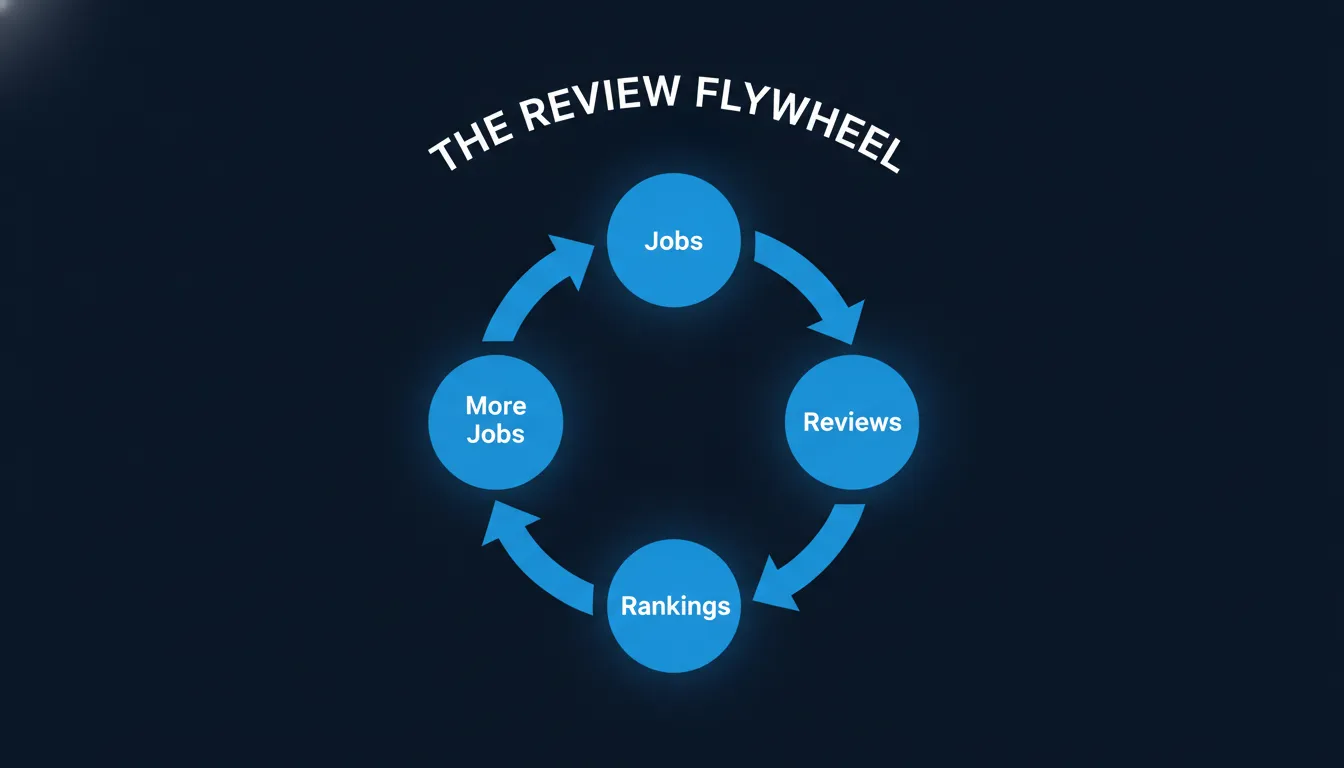
None of these sources existed for the shop when it was under $20,000 a month. Now, every single day, bookings come in from SEO work that went in months ago. SEO is probably the cheapest advertising channel there is, but very few owners ever do it because it’s not immediate. Nobody wants to wait, so in most cases nothing ever changes. Meanwhile, in any given local market, your competitors are not doing it. It’s easy to beat them.
You know the saying: the best time to plant a tree was 50 years ago. The second best time is today. Same goes for SEO. You can make a ton of progress just by getting location pages up and submitting them in Google Search Console. Most of those pages have no competition at all. Individually they won’t bring a ton of traffic, but collectively they pick up some of the highest-intent buyers nobody is competing for.
In total, this channel has produced 164 bookings, and it’s been growing every month.
Source 3: Paid search (today’s money)
Last but not least, our biggest source of bookings. This is today’s money, the thing you can start making happen right now.
A lot of people on the internet live in a world of either/or. You either do SEO or you do ads. I live in the world of doing everything, as well as you possibly can.
Go search on Google right now and look at how the page displays results. At the top: Local Services Ads. Under that: paid search ads. Under that: the map pack. Below that: the organic listings. There are lots of ways to get seen on that page. Most companies aren’t good at even one of them. We try to be good at all of them. Instead of one placement on the page, we’re getting two or three, depending on where we rank organically.
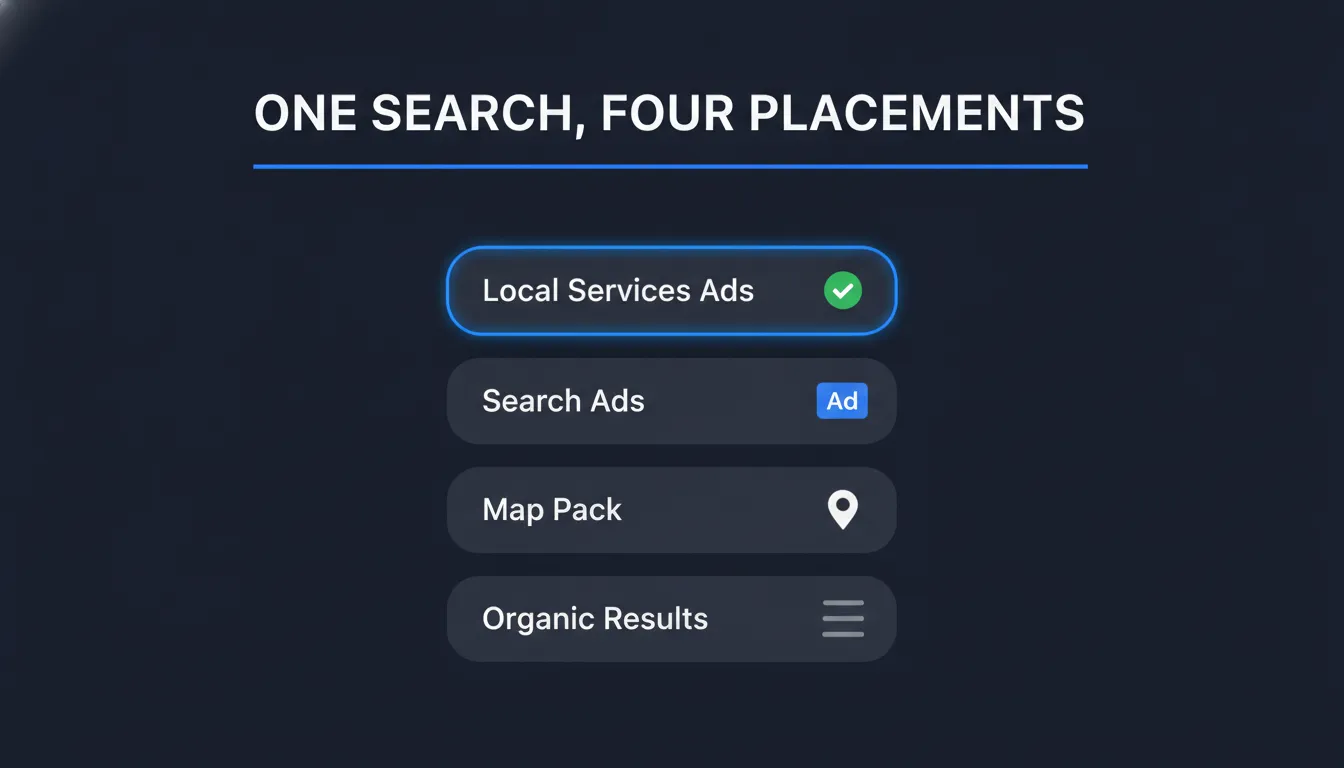
The nice thing about paid search is it gets you traffic today, jobs today, money in your pocket today. And when you get reviews on that work, it fuels everything else we’ve talked about. That’s why the flywheel is working so well and why the shop turned around so quickly.
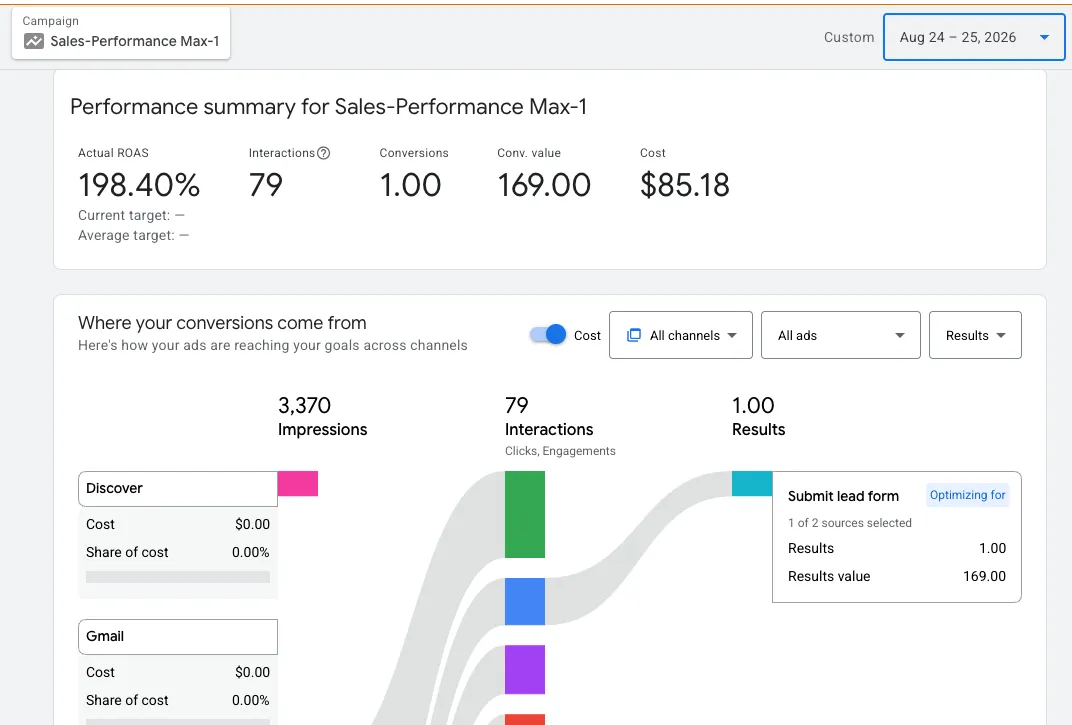
Here’s a live snapshot from the shop’s Google Ads account — a $169 interior detail booked on $85.18 of spend:
Want an easy win you can apply today? Go to Google Ads and set up a campaign on your own brand name. If your company is Bob’s Detailing, own the most prominent spot on the page when someone searches “Bob’s Detailing.” It’s cheap, because nobody is bidding on your name.
You could argue people would find you anyway. Not necessarily true. They might be comparison shopping three shops. Your job is to make it easy for them to find their way back into your world. Most people who visit your website today aren’t buying today. But what we see in our data is that the majority of the ones who do book, book within a couple of days of first touching the page. Today’s traffic truly is tomorrow’s deals.
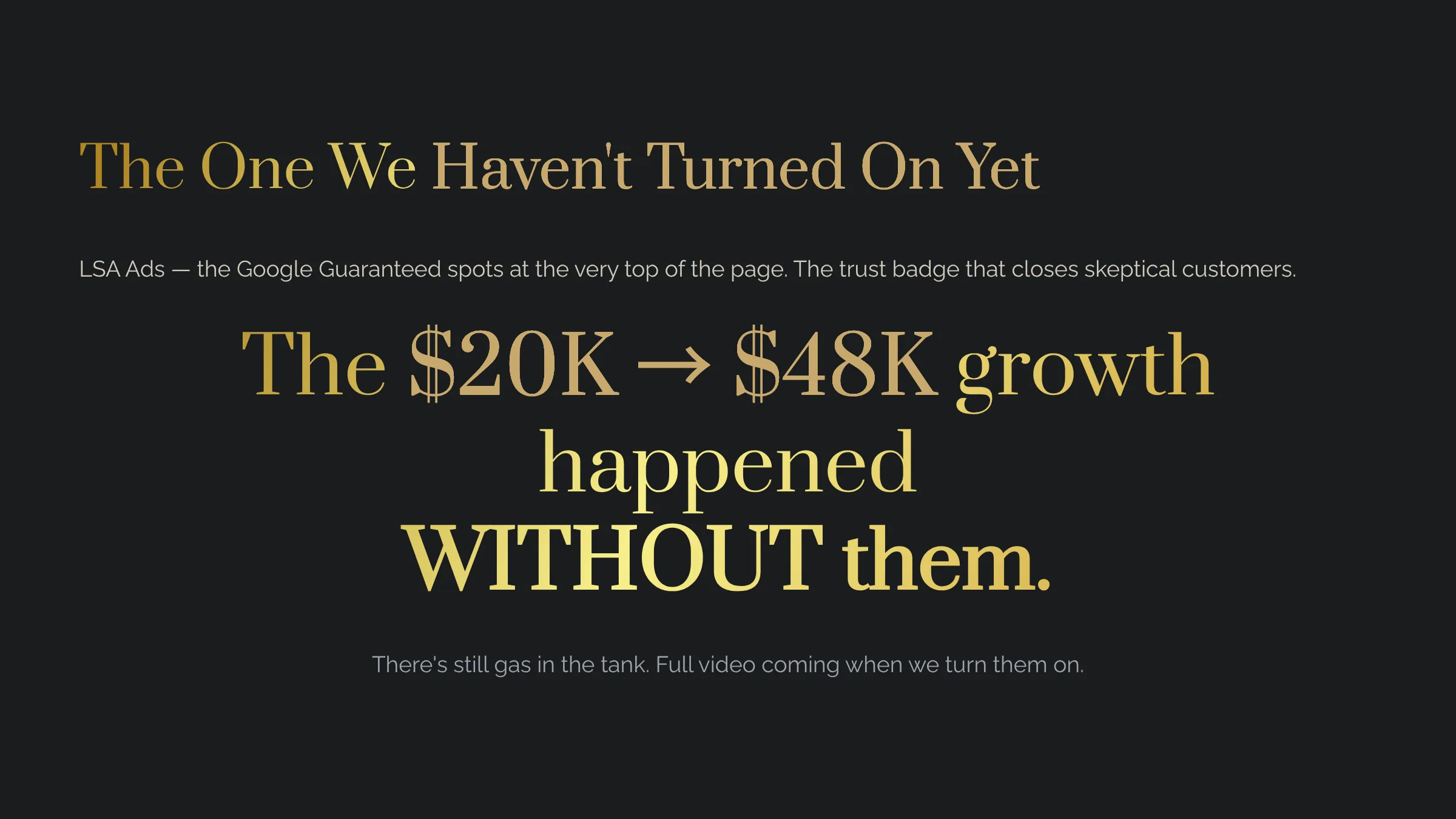
One more thing. Those Local Services Ads at the very top of the page, the Google Guaranteed ones with the green check marks? We haven’t turned those on yet. That’s the next thing we’re setting up. Everything you’ve seen here, from $20,000 a month to pacing $58,000, happened without local service ads. That should tell you something: there’s still gas in the tank. When we get them live, I’ll make a full video on exactly how it goes. There’s also more inside Google Ads itself, like Performance Max for map pack placements and AI Max for showing up in the AI suggestions.
The whole system, recapped
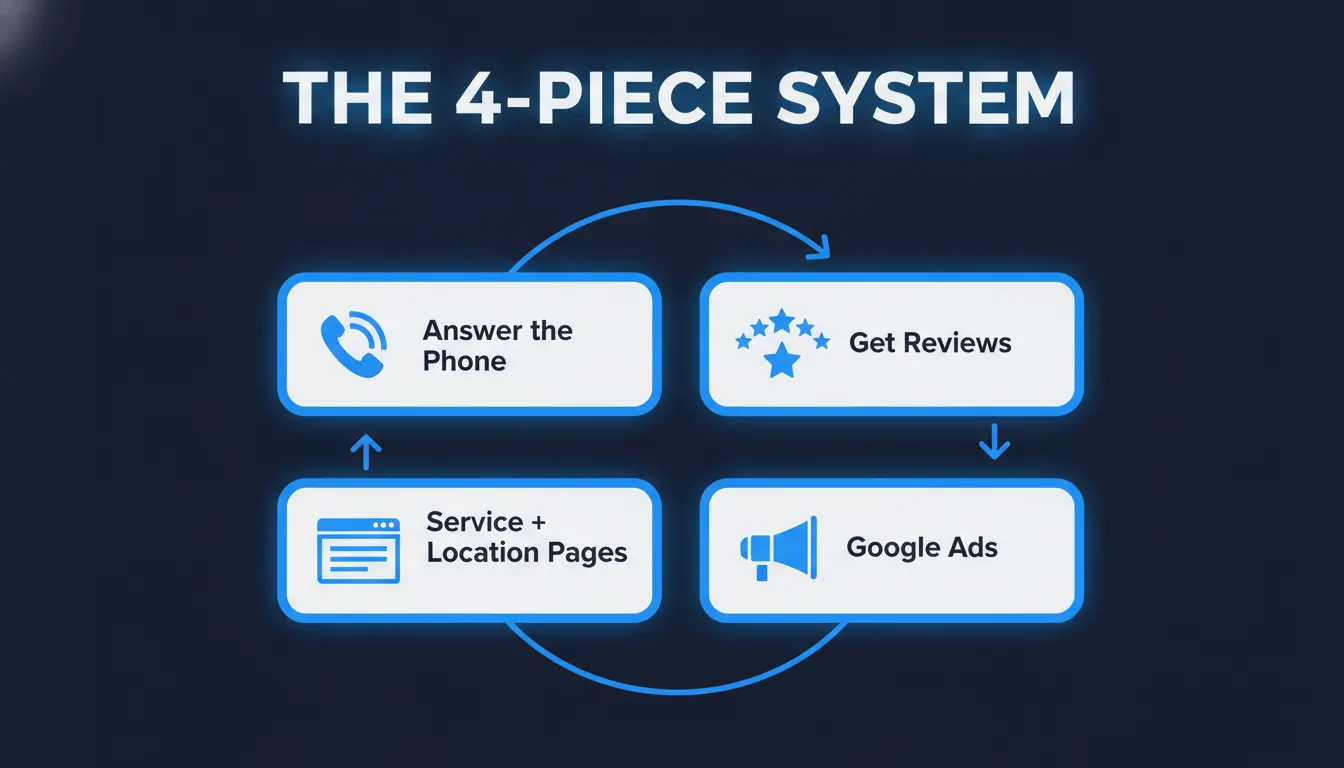
- None of this works until you answer your phone. Fix that first. You picking up every call, a voice AI catching the ones you miss, or hiring someone. Answered immediately.
- Get reviews. Every job, every time. That’s the proof engine everything else runs on.
- Put up your service pages and location pages. That’s the free traffic that compounds month over month.
- Run Google Ads on top. That’s the traffic you can turn on today, and every job it brings in feeds more reviews back into the machine.
That’s the flywheel. No single silver bullet. Four pieces that make each other stronger every week they run.
Flip through the deck
The whole case study, one number per card:
If the deck doesn’t load, open it directly on Gamma.
Follow along
I’m documenting this entire journey with the shop as it happens on my YouTube channel. Real numbers, what works, and what doesn’t. Subscribe if you want to see what happens when we turn the LSAs on.
Want the deeper breakdown of the system behind these numbers? Read the Derek’s Auto Detail case study or start with the Business Master Brain post.
Want a system like this for your business?
Check market availability →